

What are the applications of light stabilizer
Light stabilizers can be added to plastics to protect them from degradation when exposed to sunlight and weather. Polyolefins are susceptible to attack by UV light, oxygen, moisture and heat, which can lead to polymer embrittlement, surface cracking, color changes and product failure.
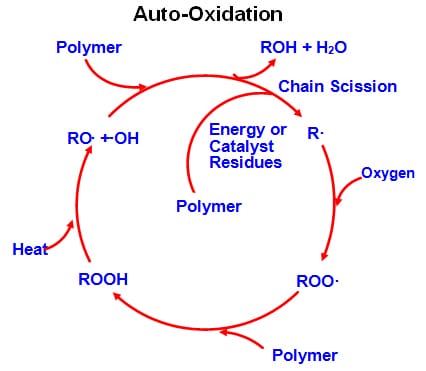
The photodegradation process involves two distinct processes. The first is photolysis, where UV radiation is absorbed and free radicals are formed due to the breaking of polymer molecular bonds. The second is autoxidation, which involves the reaction of free radicals formed during photolysis with oxygen to form peroxyl radicals. This new free radical then attacks the polymer backbone, producing another free radical. As the process progresses, more and more free radicals are formed and more and more polymer molecules are oxidized. The auto-oxidation cycle is shown in the figure below.
Light stabilizers for polyolefins are mainly divided into three categories.
UV Absorbers: Typical examples are benzophenones and benzotriazoles. These are low-cost, effective stabilizers that work by absorbing UV light. They are effective for short-term exposures.
Nickel Quencher: An energy transfer agent that acts by "quenching" the excited state of the carbonyl group formed during photooxidation and by decomposition of hydroperoxides. These types of stabilizers are not widely used because they contain heavy metals, impart color to the final product, and are not as effective as the HALS discussed in the next paragraph.
Hindered Amine Light Stabilizers (HALS): The most effective light stabilizers for polyolefins. Available in a wide range of molecular weights and structures to suit virtually any application. They can also be used as long-term heat stabilizers (HATS). They work by "trapping" free radicals formed during photooxidation. Since all three stabilizer types work through different mechanisms, they are often used in combination to create a synergistic effect. For example, HALS are often used with benzotriazoles to minimize color change in coloring systems. All of the above stabilizers will work most effectively in the presence of an appropriate base stabilization package comprising primary and secondary antioxidants and residual catalyst neutralizer.
It is important to note that product specification, geographic location and chemical environment of exposure are key factors in determining the amount of stabilizer required for a particular application.


